

Can this Rust Belt Democrat successfully carry the pro-working-class agenda in ’28?

The gubernatorial elections last month in Virginia and New Jersey showed that Democrats can win if they focus on issues of affordability – the new buzzword in national politics. And the Democratic Party’s field of potential 2028 presidential candidates appears to be taking notice. At a recent UN Climate Summit in Brazil, California Gov. Gavin Newsom suggested reframing the climate debate as a “cost-of-living issue.” And at his announcement earlier this year that he would seek a third term as Illinois governor, JB Pritzker angrily declared, “Everything is too damn expensive, from groceries, to mortgages, to cars, to health care.”
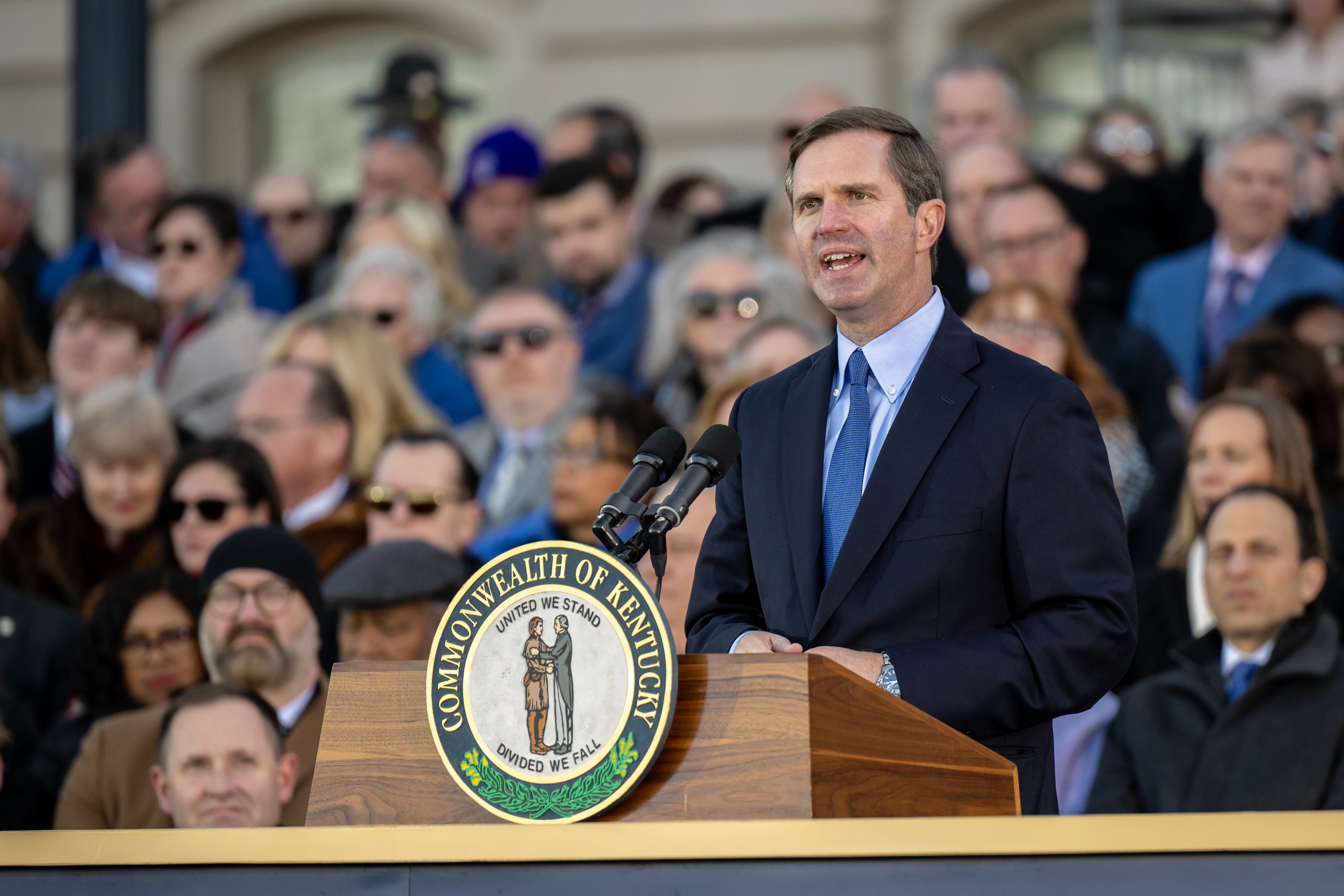
But what if a promise of helping Americans to merely eke out a living is not enough to win the next presidential election? Among the potential 2028 Democratic presidential aspirants, Kentucky Gov. Andy Beshear appears to be staking out a position that, in addition to tackling affordability and cost-of-living issues, puts the American Dream back on the table. In fact, in a recent op-ed for The Washington Post, Beshear writes, “To truly lead again, Democrats must be the party of aspiration.”
Beshear makes the case that Democrats need to give voters something more than life’s basic necessities: “When I look at our country, what worries me is the widespread belief that the American Dream is unattainable, even dead. Families know how much their grocery and utility bills have gone up, and how unaffordable rent or the mortgage is getting. But they also know that the vacation they took as children has slipped out of reach.”
Beshear has not announced any pursuit of higher office, but has a solid foundation for doing so. He is the incoming Chair of the Democratic Governors Association, faces a gubernatorial term limit in 2027 and has undertaken the modern version of a get-to-know-me speaking tour: the Andy Beshear Podcast.
The message from Beshear – who has won two terms as governor in a state that Donald Trump won by 30 percentage points – reminds me of another Rust Belt Democrat who has won office in Trump country. In 2016, of the 300,000 people who voted in Ohio’s 13th congressional district, 45,000 voted for Trump for president and Democrat Tim Ryan for Congress at the same time.
I profiled Ryan in the lead-up to his unsuccessful run for the 2020 Democratic Party nomination for president. At the time, Ryan was making a name for himself as one of the few Democrats capable of communicating meaningfully with the working class. Like Beshear, Ryan implied that a bottom-up approach to economic issues fails to inspire working- and middle-class voters. Take the “Fight for $15,” the popular progressive movement for raising the minimum wage. Ryan told me that while that might play well in coastal Democratic strongholds, it didn’t resonate in the Rust Belt, where former steelworkers and autoworkers are bemoaning the decline of wages that kept their families on an upward trajectory for much of the 20th century.
“If you’re on Meet the Press and Chuck Todd asks, ‘What’s the economic plan for the Democrats?’ and you lead with a $15 minimum wage, that’s great,” Ryan said. “But if you were making $40 an hour 10 or 15 years ago, it doesn’t speak to your aspiration.”
Speaking of $40-an-hour jobs, in his WaPo op-ed, Beshear claims that bringing 320 such jobs to Kentucky’s Henderson County – by way of a new green recycled paper mill there – increased his winning margin in that county by double digits in his reelection. Something he’d like national Democrats to emulate. In 2020, Ryan made such a pitch, centering his presidential campaign around making the U.S. the preeminent manufacturer of batteries and charging stations for electric vehicles. But in a 2020 primary race dominated by Bernie Sanders and Joe Biden, Ryan’s pro-working-class agenda never got much traction.
Perhaps in 2028, without Sanders or Biden on the ballot, Beshear may have an opening to successfully carry a pro-working-class agenda. Especially as a Democratic two-term governor of a red state. Add to that a growing consensus amongst Democratic Party operatives that Democrats need to prioritize economic issues over social concerns. In fact, as reported here on GS4D, of all the 2024 postmortems thus far, the one that deserves special attention is Working-Class Social and Economic Attitudes, an analysis by the Center for Working-Class Politics and Jacobin. Its conclusion is that an economic policy that prioritizes the working class – focusing on predistributive policies like middle-income wages, stronger pensions, stronger worker protections and union rights, as opposed to redistributive policies like cash and food assistance – would make for a strong foundation for a successful campaign.
As Jared Abbott, the director of the Center for Working-Class Politics and a primary author of the study, told Ezra Klein, “Working-class people tend to like those predistributive policies a lot because they tap into values of respect and dignity and status.
“It’s like: I actually care about having a job. You can say that if I lose my job to A.I. or to automation or whatever, then I’m going to get a universal basic income. And then many people would say: That’s OK, but like, what am I going to do? I’ve lost my status in society. I don’t have a job. That’s where I found my respect, and that’s where I found my sense of meaning.”
As Abbott’s study concludes, “The right candidates for this plan are out there. And given our findings, the Democratic Party would be wise to embrace such candidates.” Thus far, Beshear appears to be distinguishing himself as such a candidate. As he states in his WaPo op-ed:
“Democrats should be the party that will make it possible to build a better life – one in which you’re not just making ends meet but setting your family up for long-term success…. By focusing on reviving [the American Dream], Democrats can win back voters who have been leaving the party in droves.”